
KEY POINTS
- China says imports from Africa rose 21.6% in May-September from a year earlier.
- A Chinese envoy credited China’s zero-tariff policy for African countries.
- Scholars urged both sides to turn the policy into real development gains.
China’s zero-tariff policy for African countries has begun to pay off, with imports from the continent up 21.6% between May and September from a year earlier, a Chinese envoy said, according to The Guardian.
Liu Yuxi, China’s ambassador for Forum on China-Africa Cooperation affairs, spoke at the 15th China-Africa Think Tanks Forum in Yiwu, Zhejiang province. He said the measures will improve livelihoods and give fresh momentum to Africa’s industrialization.
At the same forum, Chinese and African scholars called for closer collaboration on trade, industrialization and research. They also urged both sides to make sure the zero-tariff policy delivers tangible economic and development gains.
Making the zero-tariff policy work
Oumar Demba Ba, chief diplomatic adviser to a former Senegalese president, said rising unilateralism and trade protectionism make stronger China-Africa cooperation necessary. That is especially true, he said, after China extended zero-tariff treatment to African countries with which it has diplomatic ties.
So he urged stakeholders to implement the policy through existing frameworks, including the Belt and Road Initiative and FOCAC, and to study the conditions needed to make it effective. He also called on African countries to strengthen their think tanks and build independent narratives that challenge long-standing prejudices about the continent.
Africa urged to chart its own path
Meanwhile, Balew Demissie, a senior consultant at Ethiopia’s Policy Studies Institute, said Africa should pursue a development path suited to its own circumstances rather than a single model of modernization. That strategy, he added, must reflect the aspirations of Agenda 2063.
He urged research institutions on both sides to move beyond sharing information and jointly produce knowledge that can shape development policy and global governance. He also called for deeper cooperation on policy research, exchanges among young scholars and emerging challenges such as artificial intelligence.
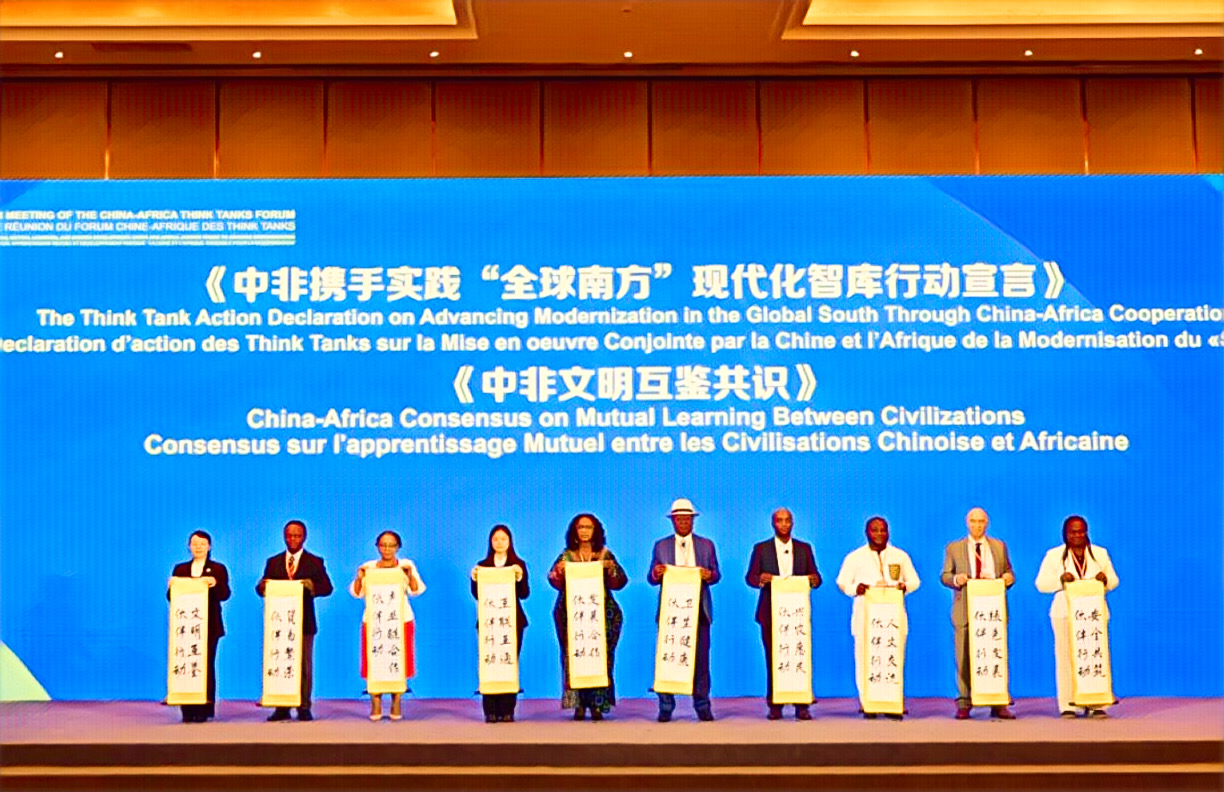
At the opening, scholars also unveiled two documents: a think tank action declaration on China-Africa cooperation to advance modernization in the Global South, and a consensus on mutual learning between civilizations. Both aim to promote research partnerships and exchanges of governance experience.